*This post may contain affiliate links to support the cost of this blog. At no cost to you, I may make a small commission if you purchase through these links. Read our Privacy Policy HERE
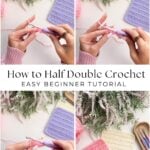
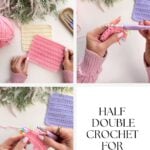
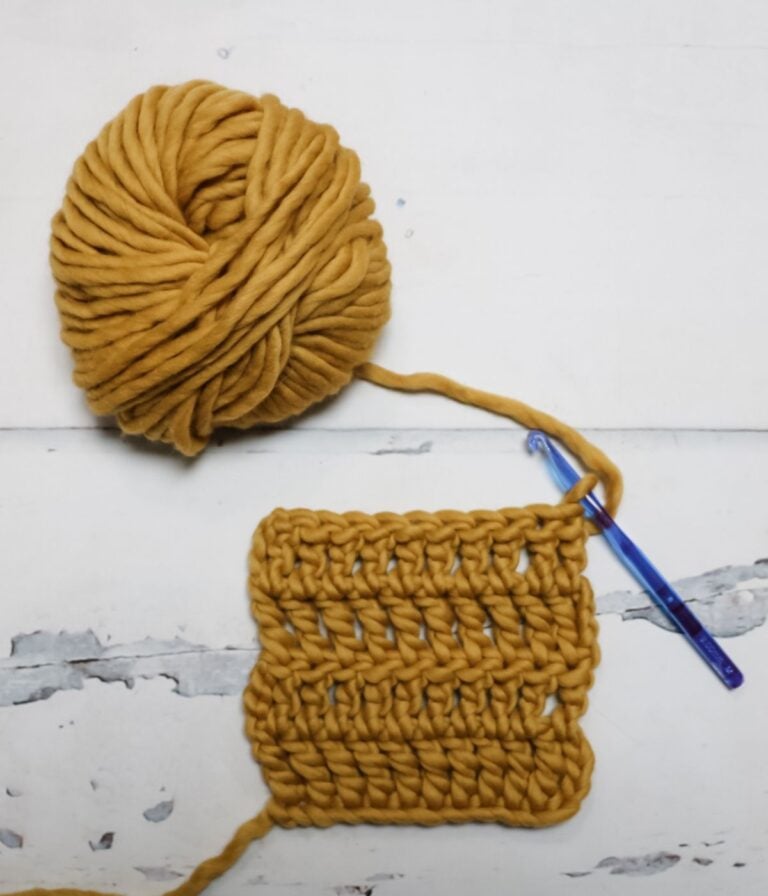
Half double crochet is a significant next step once you’re comfortable with single crochet. It sits right between single crochet and double crochet in height and creates a fabric that is slightly taller and softer than single crochet, without feeling too loose.
This stitch is often used in garments, blankets, and accessories, and it helps you begin to understand how yarn overs affect stitch height and fabric drape.

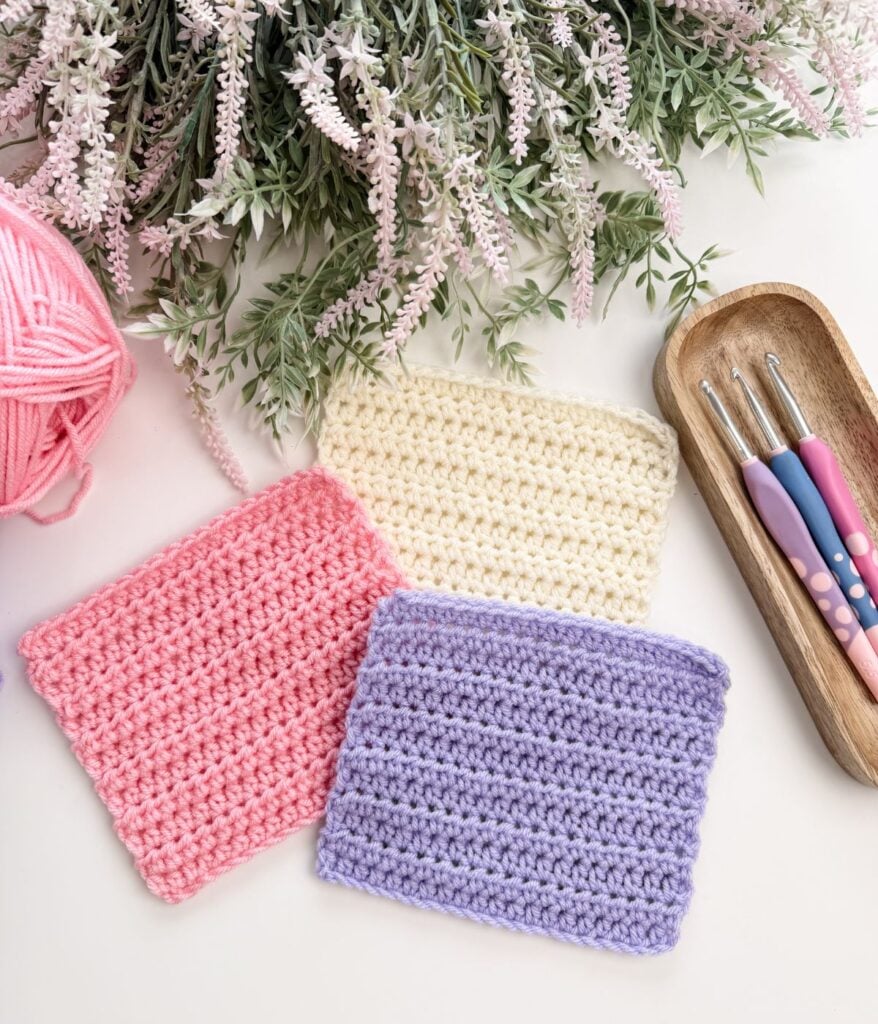
What Is Half Double Crochet?
The half double crochet is a medium-height stitch. It is taller than single crochet but shorter than double crochet.
In crochet patterns, half double crochet is abbreviated as hdc.
Because this stitch adds a yarn over at the beginning, it introduces an important concept you’ll see in many other stitches as we advance.
How Half Double Crochet Is Different from Single Crochet
The main difference between single crochet and half double crochet is the yarn over.
With half double crochet:
- You yarn over before inserting your hook
- You will have three loops on your hook before completing the stitch
- The stitch is taller and slightly looser than single crochet
Understanding this difference helps make taller stitches feel more logical rather than intimidating.
When you look closely at a half double crochet stitch, you’ll notice it has several distinct parts. Understanding these will make it much easier to follow patterns and try more advanced techniques later on.
Stitch Anatomy of Half Double Crochet
Top of the Stitch
At the top of each half double crochet, you’ll see a small “V” shape. This is made up of two loops:
• The front loop (closest to you)
• The back loop (farthest from you)
Most patterns instruct you to work under both loops unless stated otherwise.
The Third Loop
Half double crochet has a unique feature called the third loop. After you complete a row and turn your work, look at the row you just finished from the wrong side. You’ll notice an extra horizontal bar sitting just below and slightly in front of the top “V” of each stitch. That is the third loop.
When working standard half double crochet, you will insert your hook under the top two loops, not under the third loop and front loop together. Being able to identify this clearly will help you avoid accidentally changing the structure of your stitch.
The third loop is sometimes intentionally worked into to create a knit-like ribbed texture. You’ll often see this technique used in brims, cuffs, and textured projects.
The Post of the Stitch
The vertical portion of the stitch is called the post. Some advanced stitches are worked around the post rather than into the top loops. Understanding where the post sits will help when you begin learning front post and back post stitches later on.
Becoming familiar with these parts will make new stitches feel much more intuitive.
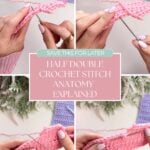
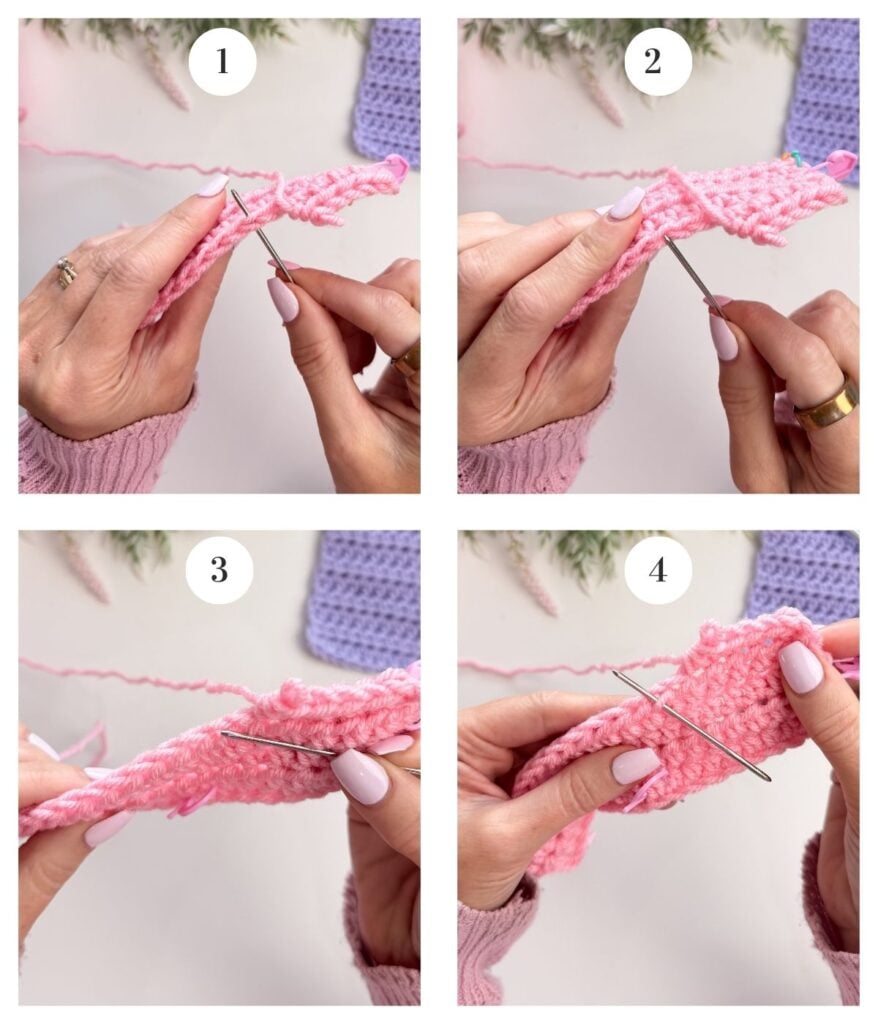
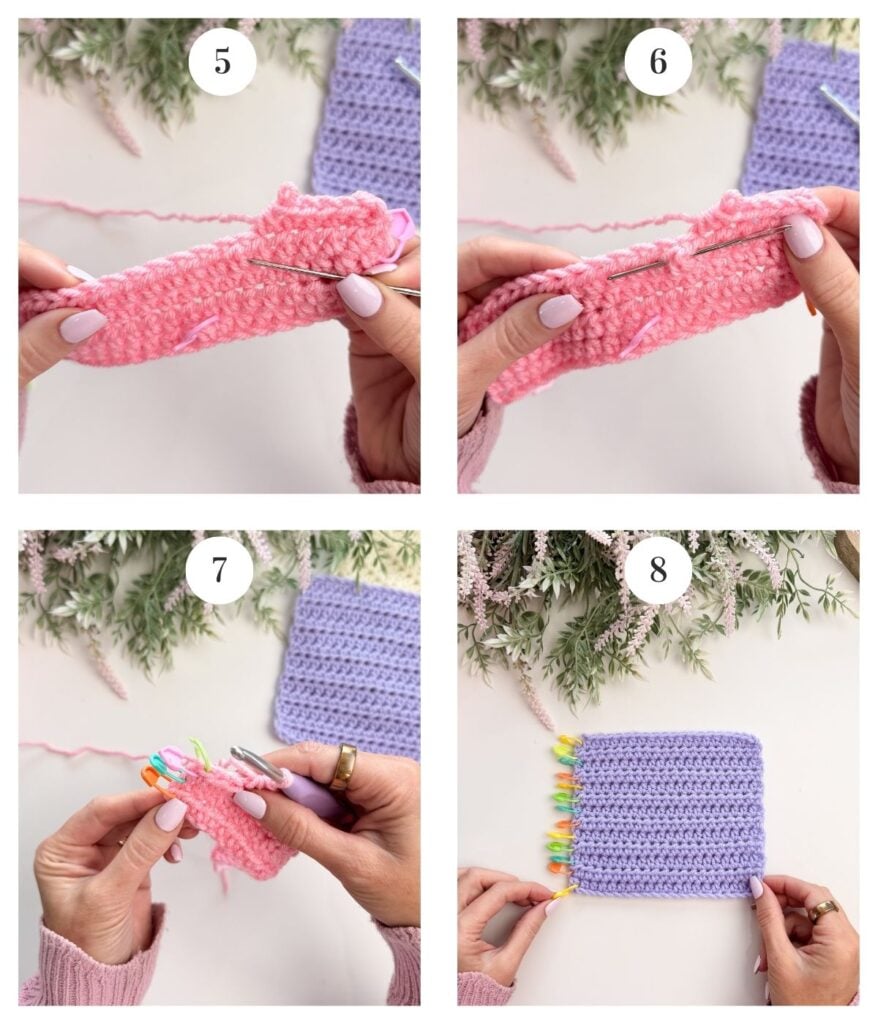
Half Double Crochet Stitch Anatomy: Visual Guide
Understanding the anatomy of your stitches will make it much easier to follow patterns and learn more advanced techniques.
In the images below, each number highlights a specific part of the half double crochet stitch:
- Front and Back Loops (the top “V” of the stitch)
- Back Loop
- Front Loop
- Third Loop
- Post of the Stitch
- Working Under Both Top Loops
- Stitch Markers for Counting Rows
- Completed Swatch with Marked Rows
Refer to these labels as you examine the close-up images to become more confident identifying each part of the stitch.
Where to Insert Your Hook
When working half double crochet:
- Insert your hook under both top loops of the next stitch, unless your pattern states otherwise
- Work under the top two loops of the stitch
- Keep your hook movements relaxed and smooth
Clear stitch placement is key to keeping your rows even.
How to Make a Half Double Crochet Stitch
To make a half double crochet stitch:
- Yarn over
- Insert your hook into the next stitch
- Yarn over
- Pull up a loop (you will have three loops on your hook)
- Yarn over
- Pull through all three loops on your hook
Repeat this process across the row.
Take your time and focus on completing each stitch cleanly before moving on.
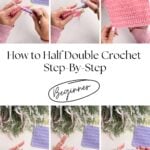
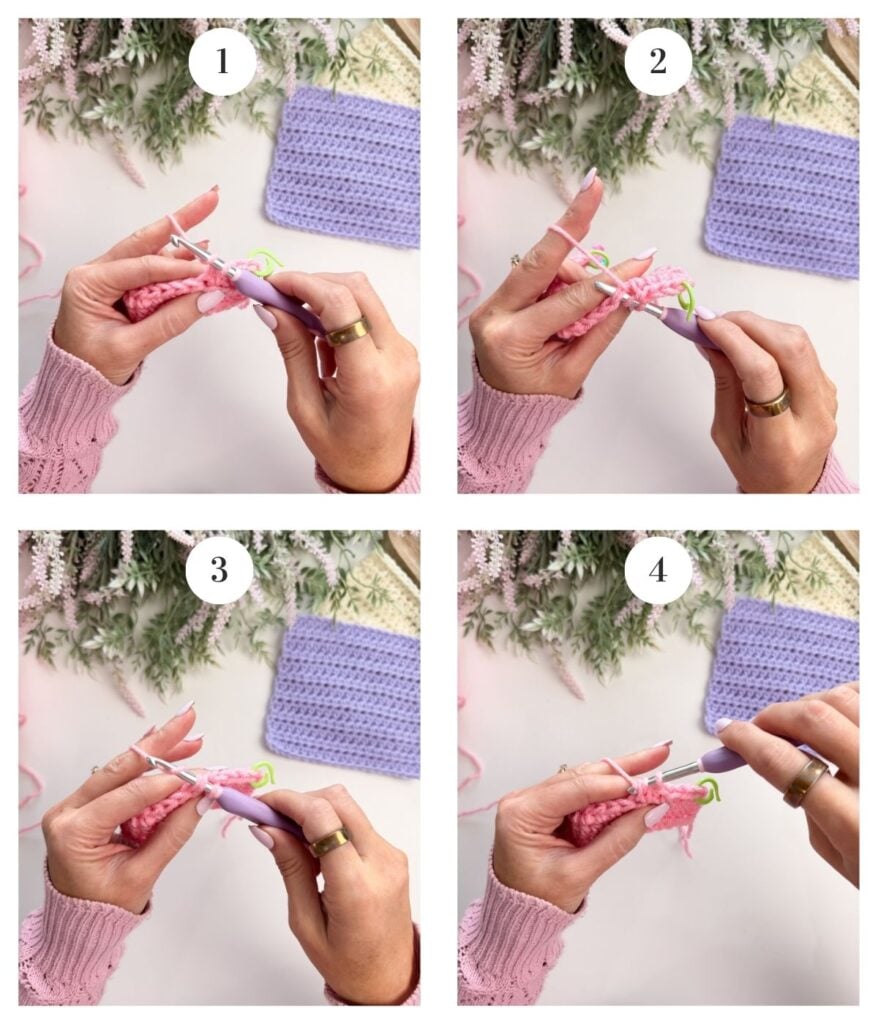
How to Half Double Crochet: Step-by-Step Visual Guide
Use the images below as a quick visual reference while practising your half double crochet stitch.
- Yarn over.
- Insert your hook into the next stitch.
- Yarn over and pull up a loop (you will have three loops on your hook).
- Yarn over and pull through all three loops on your hook.
Repeat these steps across the row.
Video Tutorial
Understanding Loop Height and Tension
One of the most important parts of creating even stitches is controlling the height of the loops on your hook.
The last working loop on your hook determines the height of your stitch. If you pull that loop too tight and let your hook tilt downward so it rests over the top of the stitch, your stitches will become shorter and tighter.
If you lift your hook too high and pull the loop upward, you’ll create a taller stitch with looser tension.
For consistent, even stitches, keep your hook riding horizontally along the top of your work. All loops on your hook should sit at an even height before completing the stitch. This helps maintain smooth edges and uniform fabric.
As you practise, pay attention to your hook angle. Small adjustments make a big difference in stitch consistency.
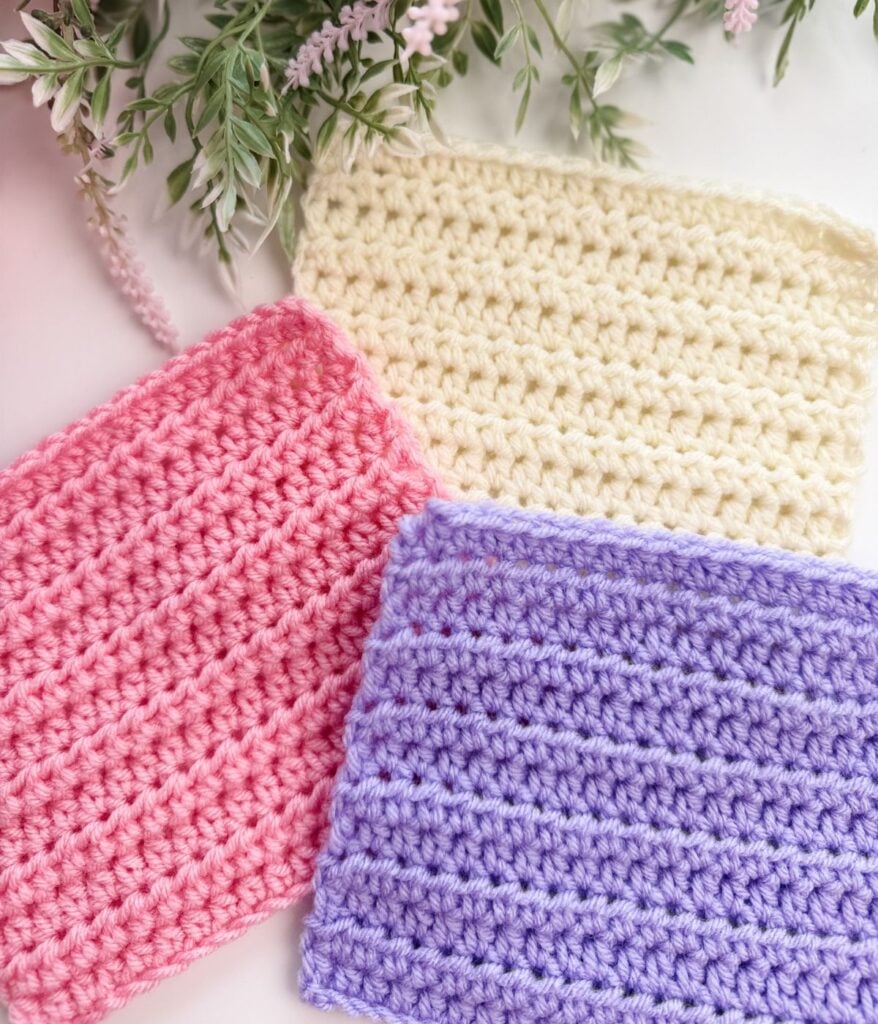
How Half Double Crochet Should Look
As you work, your half double crochet stitches should:
- Sit evenly across the row
- Be consistent in height
- Create a slightly more open fabric than single crochet
It’s normal for your tension to change slightly when learning a new stitch. That will even out with practice.
Counting Half Double Crochet Stitches
Counting stitches remains important as stitch height increases.
When counting:
- Count each completed half double crochet stitch
- Do not count the loop on your hook
- Use a stitch marker if you find it helpful
Keeping an accurate stitch count prevents shaping issues later.
Turning Your Work
At the end of the row:
- Turn your work
- Chain two
- Begin the next row in the first stitch
The chain two does not count as a stitch unless the pattern specifically states otherwise.
Traditionally, half-double crochet rows are turned by chaining 2 before starting the next row. This chain helps bring your yarn up to the height of the stitch.
That said, this is an area where personal preference comes into play.
I often turn and chain one instead of chaining two, even for taller stitches. I find this helps prevent a loose-turning chain that can create a small bump or gap along the edge of the fabric. By chaining one and starting the next stitch right away, the edges tend to look cleaner and more even.
Both methods are completely acceptable unless a pattern specifically tells you otherwise. As you crochet more, you’ll start to notice which method you prefer and which gives you the look you like best.
Common Beginner Mistakes
Some common challenges with half double crochet include:
- Forgetting the initial yarn over
- Pulling through the loops unevenly
- Working too tightly
- Missing the first or last stitch
These are all part of the learning process. If needed, pull back a few stitches and try again.
Practise Before Moving On
Before continuing, practise:
- Working several rows of half double crochet
- Watching how the stitch height changes
- Counting stitches at the end of each row
- Turning your work consistently
This practice will make the next stitch feel much easier.
What’s Next
Now that you’ve learned the half double crochet stitch, you’re ready to move on to the double crochet stitch.
Double crochet adds even more height and creates a softer, more open fabric. It builds directly on the skills you’ve just practised, especially understanding yarn overs and stitch anatomy.
Head to the next lesson in the Learn to Crochet series to continue building your foundational skills.
Helpful Resources
If you ever need to revisit this stitch, you can return to this guide and practise working several rows until it feels smooth and consistent.
This lesson is part of the Learn to Crochet course by Michelle Moore of MJ’s Off The Hook Designs, based in Lakefield, Ontario, Canada.
Thank you so much for learning with me. I hope this lesson builds your confidence and inspires you to keep practising and enjoying the process of crochet. Designs. I hope this lesson encourages you to keep practising and enjoying the process of crochet.
You can find crochet patterns in our Ravelry and Etsy shops.
For daily inspiration and behind-the-scenes peeks, join me over on Facebook or Instagram or join our YouTube Membership for exclusive content!
You’ve got questions, we’ve got a community!
Crocheting is better with friends! Join our group to post pictures and ask all your pattern support questions.