*This post may contain affiliate links to support the cost of this blog. At no cost to you, I may make a small commission if you purchase through these links. Read our Privacy Policy HERE
Choosing the Right Size, Understanding Ease, and Getting the Fit You Want
One of the most common questions we hear when making crochet garments is:
“Why doesn’t this fit the way I expected?”
This is a very common experience and rarely indicates a problem with the pattern itself. In most cases, fit surprises come down to how finished measurements, ease, fabric behaviour, yarn choice, and body proportions work together.
This post builds on:
• How to Measure Your Body for Crochet Garments
• Why Gauge Matters (and How to Measure It Correctly)
Reading all three will give you the clearest picture of how crochet garments are designed to fit and how to choose the size and style that works best for your body.
“This Pattern Runs Large” (When That’s Not Actually the Case)
It is very common to hear statements like “the patterns run large” or “the patterns run small.” In most cases, that is not what is happening.
More often, fit issues come from one or more of the following:
- Body measurements were guessed instead of measured
- “To fit” sizing was used without comparing finished measurements
- The intended ease of the design was not considered
- Body proportions changed how the garment sat on the body
- Yarn choice affected drape and structure, even when gauge matched
Crochet patterns give you the tools to be successful:
- Gauge information
- A size chart
- A schematic with finished measurements
- Notes on intended ease and fit
Your role as the maker is to use those tools together to choose the size and fit you want.
Crochet Patterns Are Built on Math
Crochet garment patterns are created using:
Gauge math
Stitch counts
Finished garment measurements
When the gauge is met and stitch counts are followed, the garment should match the measurements listed in the size chart and schematic.
Gauge confirms the math.
However, fabric behaviour still plays a role. As a garment grows in size, the weight of the fabric, the fibre content, and the stitch pattern can slightly affect how the piece relaxes, stretches, or drapes once worn.
Fit depends not only on matching the measurements, but also on how those measurements interact with your body and how the fabric behaves at full size.
Body Measurements vs Finished Garment Measurements
Body measurements are your actual measurements: bust, upper chest, waist, hips, upper arm, and torso length.
Finished garment measurements are the measurements of the completed garment, including the ease built into the design.
When choosing a size:
- Compare your body measurements to the finished garment measurements
- Do not rely only on the “to fit” range
The finished measurements tell you how the garment will actually fit once it is made.
For sweaters, especially top-down designs, it can also be helpful to check your upper bust measurement. Shoulder width and armhole depth are based on your frame, not just the fullest part of your bust. Starting with your upper bust helps ensure the garment fits correctly through the shoulders before evaluating ease through the body.
Compare All Sizes Before You Start
Before starting a garment:
- Take accurate body measurements
- Review the schematic and finished measurements
- Compare measurements across all sizes, not just the suggested one
This allows you to:
- Avoid accidental oversized results
- Choose the amount of ease you actually want
- Identify whether length, sleeve, or shaping adjustments may be helpful
Choosing a size is not about finding the “correct” number.
It is about choosing the fit you want.
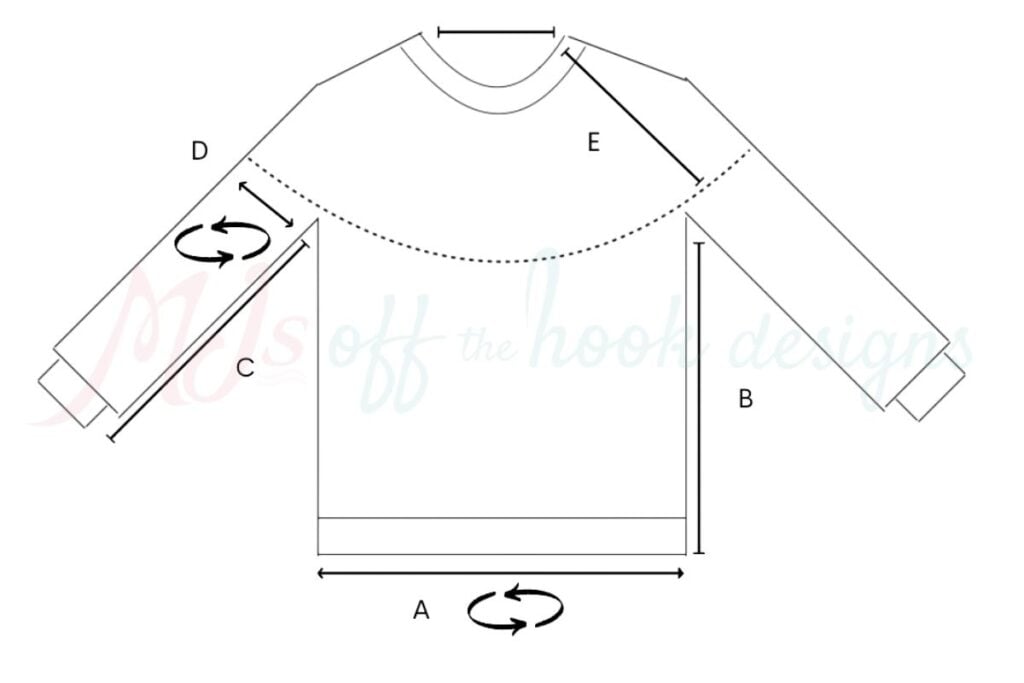
Example: Why comparing sizes matters
If your bust measures 40 inches, this typically places you in a size Large according to the “to fit bust” range in the size chart below.
However, looking at the finished garment measurements tells a much more important story.
Using the Granny Pop Pullover size chart as an example:
- Size Large finished bust: 46 inches
- This provides 6 inches of positive ease at the bust
Because the bust is usually the fullest part of the body, that same straight or unshaped garment can create significantly more ease through the waist and torso. For many people, this can result in 8 to 10 inches of positive ease through the midsection, creating a very oversized silhouette.
If you know you do not enjoy oversized garments, sizing down may be the better choice.
For comparison:
- Size Medium finished bust: 42 inches
- Provides approximately 2 inches of positive ease at the bust
- Sits closer to the body while still allowing comfort and movement
- Based on Craft Yarn Council standard body proportions, this can still result in up to 4 inches of ease through the waist
If you prefer a more fitted silhouette, you could even choose:
- Size Small finished bust: 38 inches
- Creates negative ease at the bust
- Results in a close-fitting, body-hugging garment
None of these choices is right or wrong.
- The correct size is the one that matches:
- Your body measurements
- Your comfort level
- The style and fit you want from the finished garment
Industry sizing standards, including those published by the Craft Yarn Council, provide a consistent framework for grading crochet garment patterns. Reviewing all sizes and finished measurements before starting allows you to use those standards intentionally and choose a fit that aligns with your preferences.

Understanding Ease
Ease is the difference between your body measurement and the finished garment measurement.
Negative ease
- The garment is smaller than the body
- Creates a fitted, body-hugging look
- Common in hats, cuffs, socks, and fitted garments
Zero ease
- Garment closely matches the body measurement
- Creates a very close fit
- Less common in crochet due to the fabric structure
Positive ease (relaxed fit)
- Typically 1 to 3 inches larger than the body at the bust
- Creates a comfortable everyday fit
Positive ease (oversized fit)
- Often 4 to 10 or more inches larger than the body
- Creates an intentionally roomy silhouette
- Especially noticeable in straight or unshaped designs
Understanding the intended ease of a design is essential when choosing your size.
Why a garment can look oversized even when the math is correct
Most crochet sweater sizing is based on bust measurement, using established industry sizing standards.
However, bodies vary widely in proportion.
- Some people have:
- A smaller waist than bust
- A fuller waist or torso
- Fuller hips than bust
- A straighter shape with minimal difference between measurements
Straight or unshaped garments distribute ease evenly from top to bottom. That means the added ease required to fit one area of the body will continue through the rest of the garment.
As a result:
- If your waist or torso is smaller than your bust, ease may appear more noticeable through the midsection
- If your hips are fuller than your bust, the garment may feel snug or sit differently on the lower body
- If your torso is fuller overall, ease may feel concentrated higher or lower, depending on garment length and shape
In all cases, the garment is behaving as designed based on standard sizing and construction.
This does not mean the pattern runs large or small.
It means the pattern is graded using a consistent system, while bodies are individual.
Understanding how ease distributes across different body proportions helps explain why a garment can fit correctly in one area and feel unexpected in another.
Yarn Choice, Drape, and Fabric Behaviour
Yarn choice can significantly change how easy it appears, even when the gauge is correct.
- Yarns with more drape
- Fall closer to the body
- Soften the appearance of ease
- Yarns with less drape
- Hold structure
- Emphasize straight silhouettes
- Make ease appear more pronounced
This is why:
- Swatching matters
- Fibre content matters
- Fabric feel matters just as much as stitch count
Patterns Use Standards, Bodies Are Individual
Garment patterns are graded using standard sizing systems to ensure consistent scaling across sizes.
- These standards:
- Provide a reliable starting point
- Allow patterns to grade accurately and consistently
They are not a guarantee of a perfect fit for every body.
Bodies vary in:
- Bust to waist ratio
- Shoulder width
- Upper chest fullness
- Upper arm size
- Torso length
Our garment measurements are based on Craft Yarn Council measurements, with ease added on top according to the intended fit of the design.
Patterns provide the framework.
Your measurements, proportions, and fit preferences guide the final result.
Top-Down Garments and Customization
Top-down construction allows for adjustments as you go.
Helpful tips:
- Try on the yoke before separating body and sleeves
- Separate once the armhole sits comfortably at the underarm
- If more room is needed after separating, add evenly spaced increases
- Place increases near the sides to maintain balance
Customization is not fixing a mistake.
It is part of garment-making.
We will dive deeper into how to customize garments in part 4 of this series, coming soon!
Why Gauge Can Be Right, and Fit Still Feel Wrong
Gauge ensures:
• Stitch math is correct
• The garment matches the listed measurements
- Fit is influenced by:
- Body proportions
- Intended ease
- Yarn choice and drape
- Garment construction and shaping
All of these work together to determine how the finished garment looks and feels.
Learn more about gauge in our beginner’s guide to gauge.
Final Thoughts on Sizing and Fit
Crochet garments do not “run large” or “run small.”
- Most fit surprises are explained by:
- Ease
- Body measurements and proportions
- Yarn choice and fabric behaviour
- How finished measurements compare to the body
When you use the size chart, schematic, and ease information together, you can confidently choose your size and make adjustments to create a garment that fits both your body and your style.
Helpful Resources
- Join our Facebook Crochet Community for pattern support and inspiration
- Subscribe on YouTube for hundreds of free tutorials
- Sign up for our newsletter and receive 40% off your first Ravelry purchase!
- Sign up for our YouTube Membership
This post is written by Michelle Moore of MJ’s Off The Hook Designs Inc, based in Lakefield, Ontario, Canada. Your go-to source for modern, easy crochet patterns. Published on January 15th, 2026.
Thank you for visiting MJ’s Off The Hook Designs. You can find more crochet patterns in our Ravelry and Etsy shops.
For daily inspiration and behind-the-scenes peeks, join me over on Facebook or Instagram, or join our YouTube Membership for exclusive content!
You’ve got questions, we’ve got a community!
Crocheting is better with friends! Join our group to post pictures and ask all your pattern support questions.