*This post may contain affiliate links to support the cost of this blog. At no cost to you, I may make a small commission if you purchase through these links. Read our Privacy Policy HERE


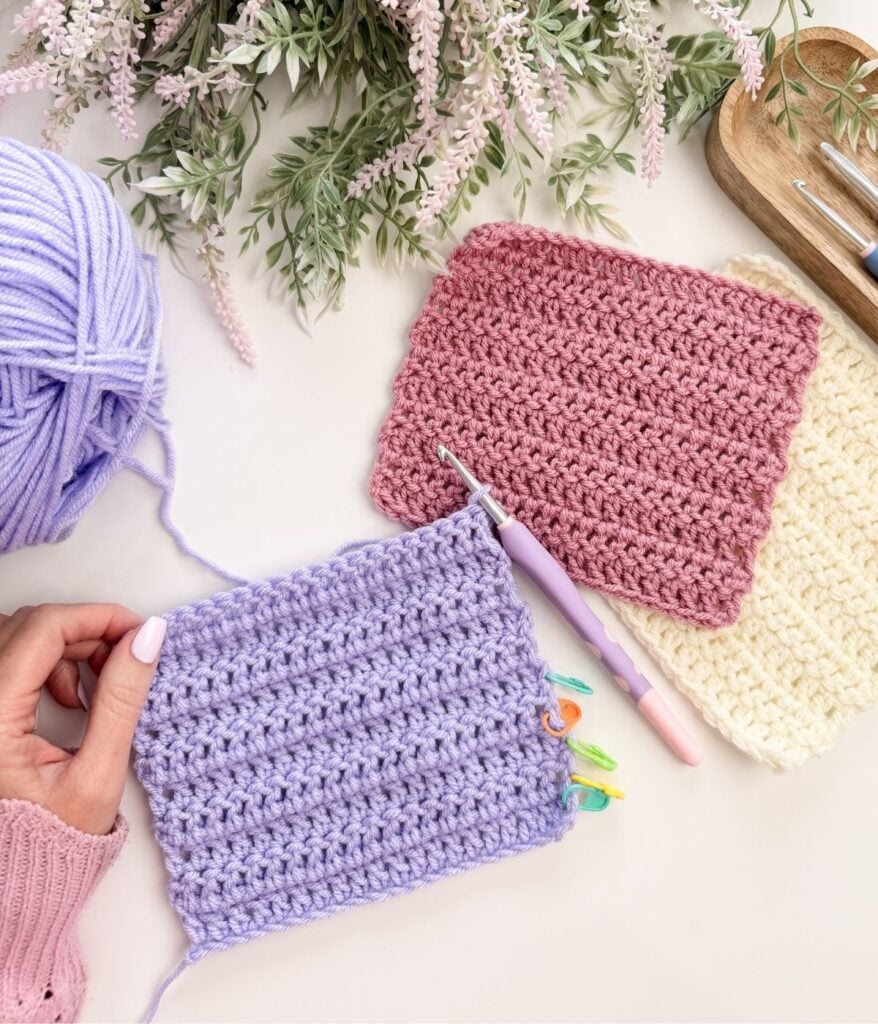
Double crochet is one of the most commonly used stitches in crochet. It creates a taller stitch than half double crochet and produces a lighter, more open fabric.
This stitch is used in everything from garments and blankets to lace patterns and home decor. Learning double crochet will significantly expand the types of projects you can make.
Take your time with this lesson. Although the stitch is taller, the steps will feel very familiar if you’ve worked half double crochet.
What Is Double Crochet?
Double crochet is a tall stitch that creates a flexible fabric with more drape than shorter stitches.
In crochet patterns, double crochet is abbreviated as dc.
Because this stitch adds an extra step, it’s a great way to understand further how yarn overs affect stitch height and fabric structure.
How Double Crochet Is Different from Half Double Crochet
The main difference between half double crochet and double crochet is how the loops are worked off the hook.
With double crochet:
- You yarn over before inserting your hook
- You will work through the loops in two steps
- The stitch is taller and more open than half double crochet
Once you understand this process, taller stitches become much easier to learn.
Double Crochet Stitch Anatomy
Understanding the anatomy of your double crochet stitches will help you place your hook correctly and keep your rows even.
When you look at a completed row of double crochet, you’ll notice a few key parts:
Top of the Stitch
At the top of each double crochet stitch, you’ll see a small “V” shape. This “V” is made up of two loops:
- The front loop (the loop closest to you)
- The back loop (the loop farthest from you)
In most patterns, you will insert your hook under both of these loops unless instructed otherwise.
The Post of the Stitch
The vertical section below the top “V” is called the post. The post gives the stitch its height and structure.
Some advanced techniques, such as front post and back post stitches, are worked around the post instead of under the top two loops. Understanding where the post sits will make those stitches much easier to learn later on.
Becoming familiar with these parts of the stitch will help you identify your first and last stitches more confidently and maintain consistent rows.
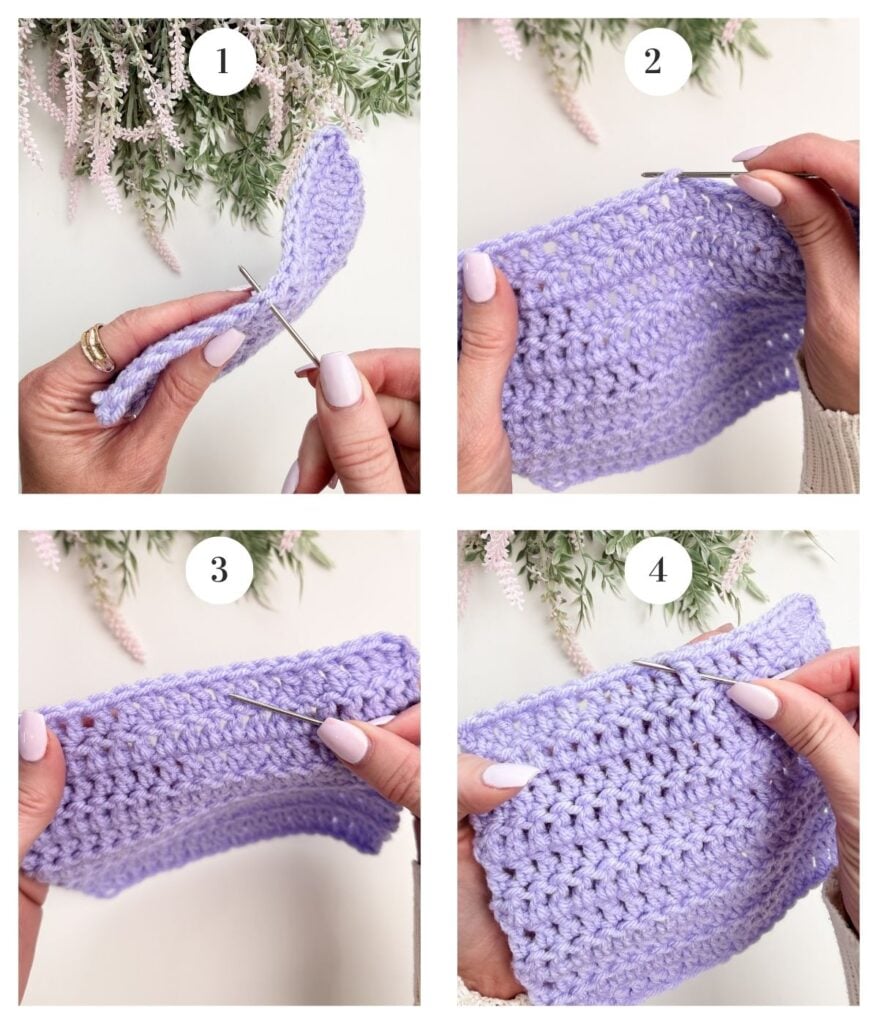
Double Crochet Stitch Anatomy: Visual Guide
Understanding the anatomy of your double crochet stitches will help you place your hook correctly and keep your rows even.
In the images below, each number highlights a specific part of the double crochet stitch:
- The top of the stitch shows the front and back loops (the “V” shape).
- Where to insert your hook under both top loops of the stitch.
- The post of the stitch.
- A closer look at the post, showing how it sits vertically beneath the top loops.
Refer to these labels as you examine the close-up images to become more confident in identifying each part of the stitch.
Where to Insert Your Hook
When working double crochet:
- Insert your hook into the next stitch
- Work under the top two loops of the stitch
- Keep your hook movements smooth and relaxed
Precise stitch placement helps maintain even rows and clean edges.
How to Make a Double Crochet Stitch
To make a double crochet stitch:
- Yarn over
- Insert your hook into the next stitch
- Yarn over
- Pull up a loop (you will have three loops on your hook)
- Yarn over
- Pull through the first two loops on your hook
- Yarn over
- Pull through the remaining two loops
Repeat this process across the row.
Focus on keeping each step consistent rather than rushing through the stitch.
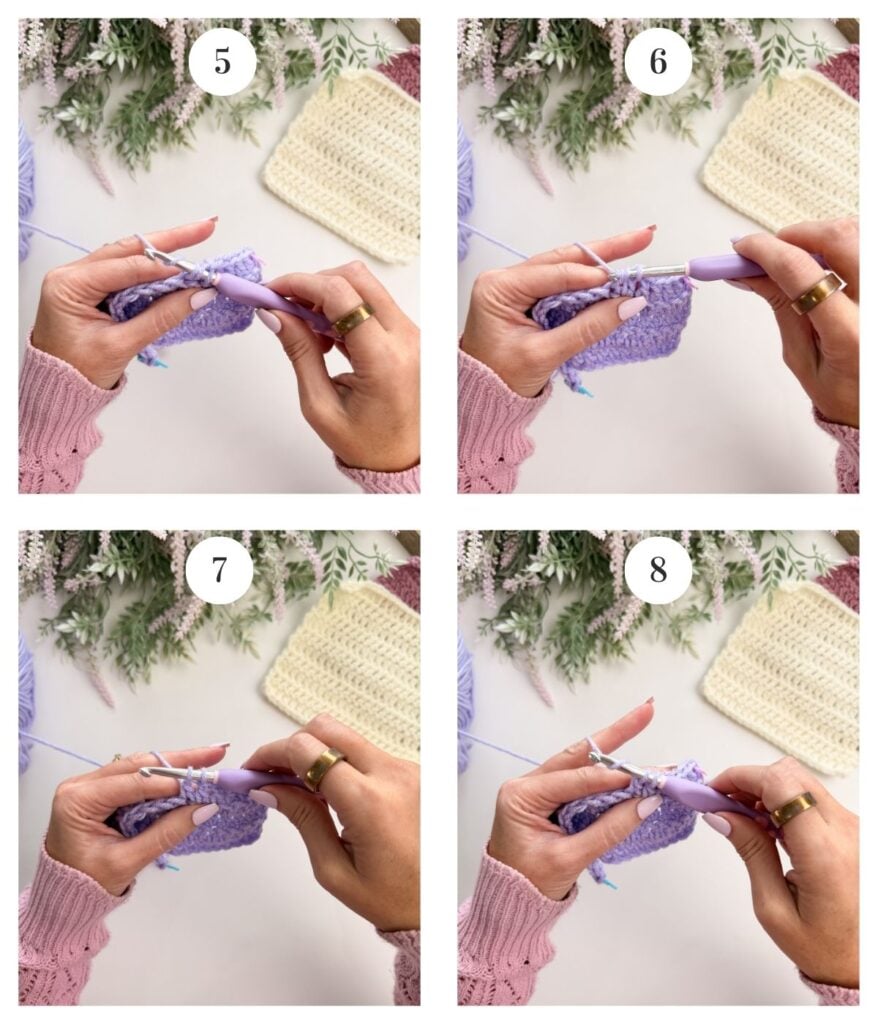
How to Double Crochet: Step-by-Step Visual Guide
Use the images below as a quick visual reference while practising your double crochet stitch.
- Yarn over.
- Insert your hook into the next stitch.
- Yarn over and pull up a loop.
- You now have three loops on your hook.
- Yarn over.
- Pull through the first two loops on your hook.
- You now have two loops remaining on your hook.
- Yarn over and pull through the final two loops to complete the stitch.
Repeat these steps across the row.

Video Tutorial
How Double Crochet Should Look
As you work, your double crochet stitches should:
- Be uniform in height
- Sit evenly across the row
- Create a lighter, more open fabric
It’s normal for your tension to change slightly as stitch height increases. With practice, your stitches will become more consistent.
Understanding Loop Height and Tension
One of the most important parts of creating even stitches is controlling the height of the loops on your hook.
The last working loop on your hook determines the height of your stitch. If you pull that loop too tight and let your hook tilt downward so it rests over the top of the stitch, your stitches will become shorter and tighter.
If you lift your hook too high and pull the loop upward, you’ll create a taller stitch with looser tension.
For consistent, even stitches, keep your hook riding horizontally along the top of your work. All loops on your hook should sit at an even height before completing the stitch. This helps maintain smooth edges and uniform fabric.
As you practise, pay attention to your hook angle. Small adjustments make a big difference in stitch consistency.
Counting Double Crochet Stitches
Counting stitches remains important as stitches become taller.
When counting:
- Count each completed double crochet stitch
- Do not count the loop on your hook
- Use a stitch marker in the first or last stitch if needed
Accurate counting helps prevent your project from changing width as you work.
Counting Rows in Double Crochet
When practising double crochet, it’s just as important to count your rows as it is to count your stitches.
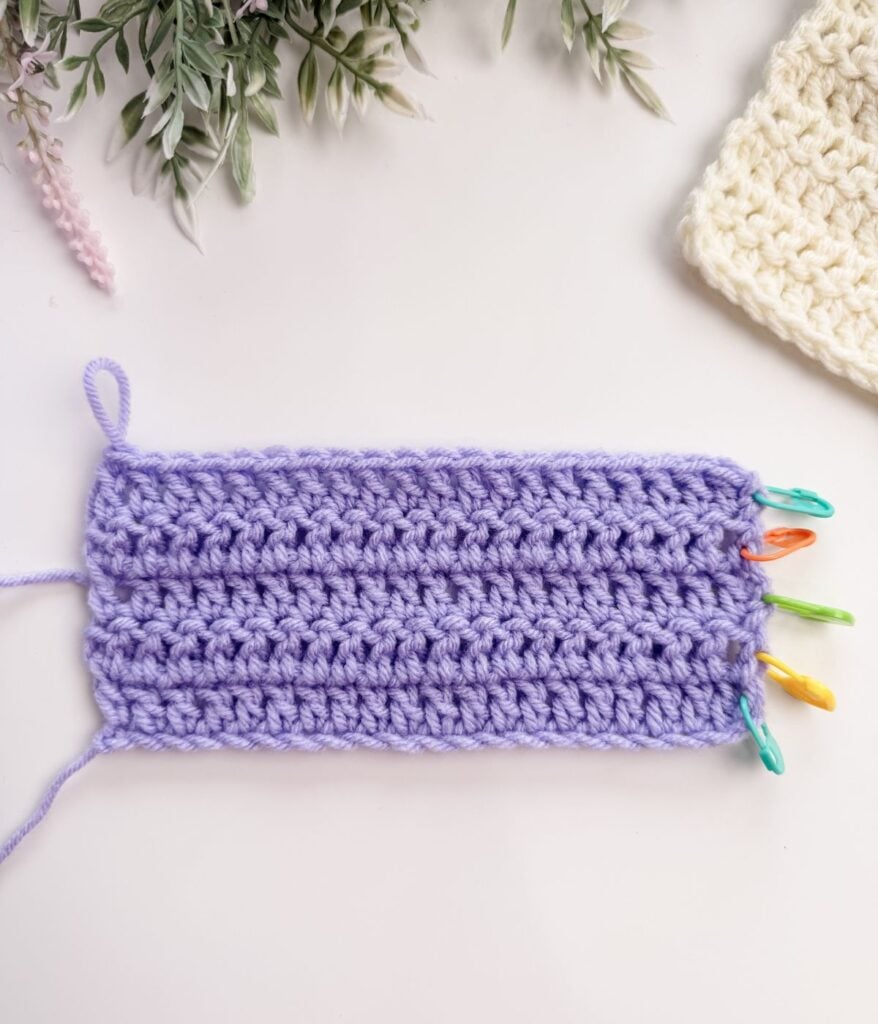
Each completed row of double crochet creates a distinct horizontal ridge. You can count these ridges from the side of your work to determine how many rows you’ve completed.
If you’re just starting out, placing a removable stitch marker at the end of each row can make counting much easier. This gives you a clear visual reference and helps prevent losing track of your progress.
Taking a moment to count your rows regularly will help keep your project even and consistent.
Turning Your Work
Traditionally, double crochet rows are turned by chaining three before beginning the next row. This chain helps bring the yarn up to the height of the stitch.
That said, this is another area where personal preference comes into play. I often turn and chain one instead of chaining three when working double crochet. I find this helps eliminate the loose-turning chain that can create a noticeable bump or gap along the fabric edge. By chaining one and starting the next stitch right away, the edges tend to look cleaner and more even.
Both methods are completely acceptable unless a pattern specifically instructs you to use a specific turning chain. As you gain experience, you’ll discover which approach gives you the look you prefer.
Common Beginner Mistakes
Some common challenges beginners experience with double crochet include:
Forgetting one of the yarn overs
Pulling through the wrong number of loops
Working too loosely or too tightly
Missing the first or last stitch
If something doesn’t look right, it’s okay to pull back a few stitches and try again.
Practise Before Moving On
Before continuing, practise:
- Working several rows of double crochet
- Watching how the fabric drapes
- Counting stitches at the end of each row
- Trying both turning chain methods to see the difference
This practice will make the next stitch feel much more approachable.
Helpful Resources
Sign up for our YouTube Membership
Join our Facebook Crochet Community for pattern support and inspiration
Subscribe on YouTube for hundreds of free tutorials
Sign up for our newsletter and receive 40% off your first Ravelry purchase!
What’s Next
Now that you’ve learned how to double crochet, you’re ready to move on to the treble crochet stitch.
Treble crochet adds even more height and openness to your fabric, building on the yarn-over techniques you’ve just practised.
Continue to the next lesson in the Learn to Crochet series to keep expanding your foundational stitch skills.
If you’d like extra practice, work several rows of double crochet and experiment with both turning chain methods to see which edge you prefer.
You’ve got questions, we’ve got a community!
Crocheting is better with friends! Join our group to post pictures and ask all your pattern support questions.